Under Pressure: What Athletes, Surgeons, CEOs, and Trial Attorneys Share


Why Nervous System Regulation Determines Performance at the Highest Levels
Pressure reveals architecture.
Not talent.
Not résumé.
Not reputation.
Architecture.
In vastly different arenas — professional sports, surgical theaters, corporate boardrooms, high-stakes litigation — individuals operate under extraordinary levels of scrutiny, consequence, and unpredictability.
Externally, these roles appear unrelated.
Internally, they are nearly identical.
They all depend on one biological system.
The nervous system.
⸻
Pressure Is Physiological Before It Is Psychological
When stakes are high, the body moves first.
Heart rate accelerates.
Peripheral vision narrows.
Cortisol mobilizes glucose.
Adrenaline prepares muscle groups for action.
The brain reallocates resources toward threat detection.
This is not weakness.
It is survival physiology.
Yet in modern elite professions, the “threat” is rarely physical danger. It is evaluation. Consequence. Financial magnitude. Reputation. Irreversibility.
The quarterback reading coverage.
The surgeon navigating a complication.
The CEO responding to market volatility.
The trial attorney pivoting under cross-examination.
Different uniforms. Same biology.
⸻
Adrenaline Is Not the Enemy
Adrenaline sharpens attention.
It increases reaction time.
It enhances readiness.
But unmanaged arousal narrows cognition.
When sympathetic activation exceeds regulatory capacity, executive functioning decreases. Working memory compresses. Cognitive flexibility drops. Language becomes reactive instead of strategic.
Under intense pressure, the brain does not “rise to the occasion.”
It defaults to its level of training.
Not tactical training.
Regulatory training.
⸻
Nature, Nurture, and Sensitivity to Pressure
Some individuals are born with higher baseline reactivity. Temperament matters.
But environment wires response patterns.
Early exposure to instability can produce hypervigilance.
Chronic evaluation can produce anticipatory anxiety.
High-achieving family systems can normalize overdrive.
Performance cultures can equate exhaustion with excellence.
Over time, professionals may become extraordinarily competent externally — while internally operating in chronic activation.
High function does not equal high regulation.
And chronic activation, even when productive, carries cognitive cost.
⸻
The Myth of Mental Toughness
Elite environments often valorize toughness.
Push through.
Stay sharp.
No excuses.
No hesitation.
But neuroscience does not reward suppression.
Suppression consumes working memory.
It reduces adaptability.
It increases delayed recovery time.
The most sustainable high performers do something different.
They oscillate.
Activation.
Recovery.
Activation.
Recovery.
They widen their regulatory window.
They do not aim to eliminate adrenaline.
They aim to expand their capacity to handle it.
⸻
Containment, Community, and Internal Safety
Whether in a locker room, operating suite, courtroom, or executive retreat, performance stabilizes in environments that foster psychological containment.
Containment does not mean softness.
It means predictability.
Role clarity.
Clear communication.
Trust.
Externally regulated systems improve internally regulated individuals.
But even in unstable environments, internal regulation can be trained.
Breath pacing.
Somatic awareness.
Cognitive framing.
Deliberate recovery cycles.
Strategic pause.
These are not “mental health tools.”
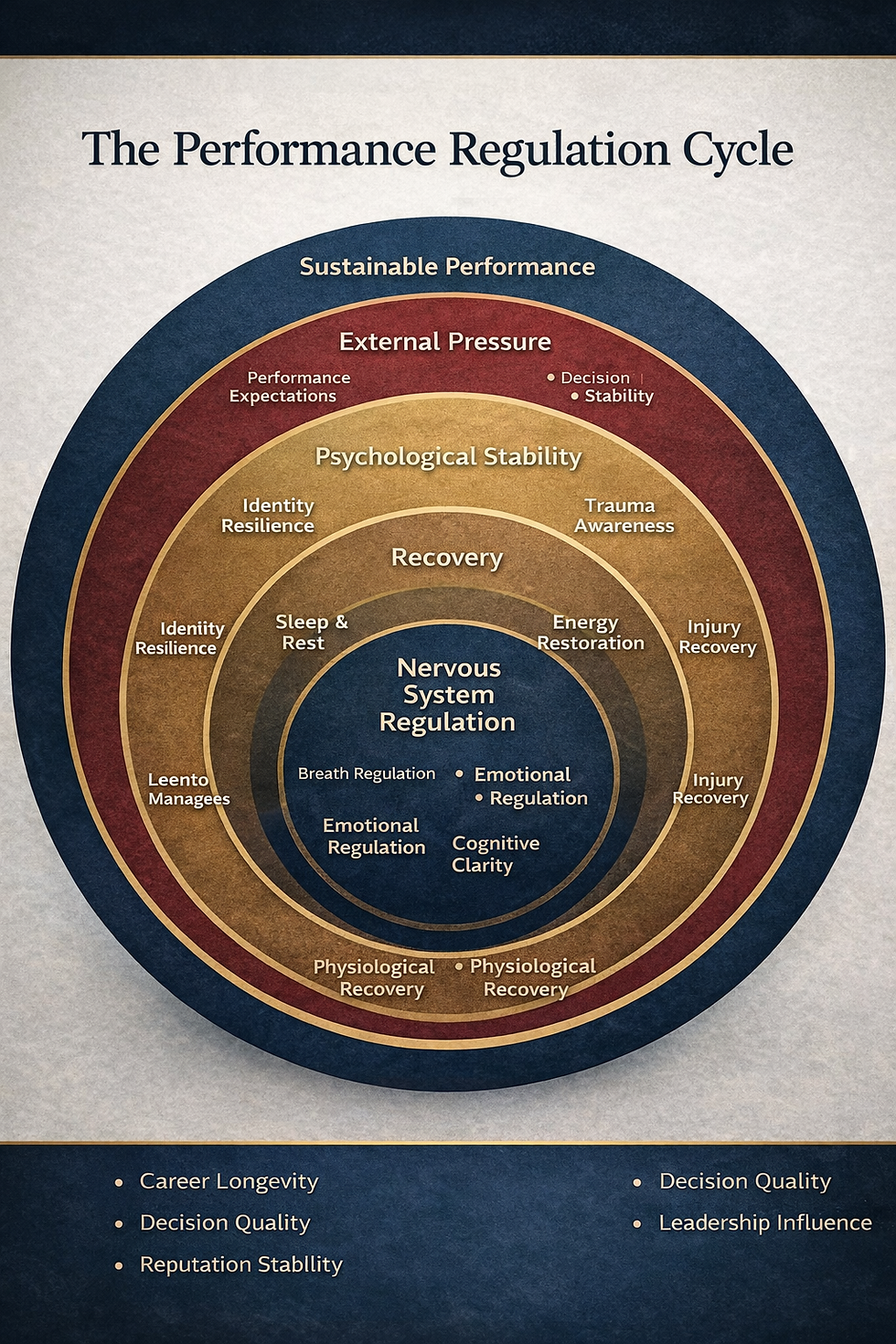
They are performance architecture.
⸻
One Mind. One Body.
The separation between mind and body is conceptual — not biological.
Thought alters physiology.
Physiology alters thought.
State influences perception.
Perception influences decision.
This feedback loop determines clarity under pressure.
The athlete who can reset after an error.
The surgeon who stabilizes after an unexpected bleed.
The CEO who slows the room instead of accelerating panic.
The trial attorney who remains composed while provoked.
They are not immune to stress.
They are regulated within it.
⸻
What They Share
Across elite domains, high performers share:
• A trained recovery response
• Awareness of physiological escalation
• Capacity to interrupt reactivity
• Deliberate regulation before execution
• Community structures that reinforce stability
Pressure does not disappear.
But cognitive access remains intact.
And that distinction changes outcomes.
⸻
A Different Definition of Power
Power is often associated with force.
But in high-stakes environments, power looks like precision.
Precision requires oxygenated cognition.
Cognition requires regulation.
Regulation requires awareness and practice.
If the body is in chaos, thought fragments.
If the body is contained, strategy expands.
This is not philosophy.
It is neurobiology.
⸻
Closing Perspective
Whether on a field, at a surgical table, in a boardroom, or before a jury — pressure is universal.
The differentiator is not grit alone.
It is the ability to remain internally organized when external stakes escalate.
Under pressure, the body speaks first.
The question is:
Have you trained it?


Comments